Thursday, September 27, 2007

Beyond Virtual Worlds : Patterns of the Future


We have been looking at what is possible with Virtual Worlds but for the next few minutes let us step out of the domain what is possible now and explore what could become possible in the next couple of years. From engineering, let us step into the domain of imagineering -- which is what this blog is all about !


Why are we constrained to 2D displays ? We are inherently 3D animals ... and the world that we are simulating virtually is supposed to be 3D. So why should we stick to traditional computer displays that render 2D images ? There are display technologies available that create 3D hologram style images ... that one can 'almost' walk around and see ( though not quite touch as yet ) Go to google and search for 3D displays and you will see stuff like what you see above and below.


Just imagine what your SecondLife, or whatever 3D world that prefer to live in, will look when you view them on a display screen like this. And interestingly enough, the cost of these display devices is not astronomical. They are obviously more expensive when compared to the standard flat screen monitors ... but certainly very affordable.

Yet the technology is not quite rocket science. We have had 3D movies using polarised light for decades. Please see the diagram below. Modern technology has used the same principles of physics and made the devices both affordable and convenient to use.


But our next question is do you need a display at all ?

Recent advances in medical science, exploring ways to make the blind see again, have created what are known as Bionic eyes. If you look at the structure and mechanics of the human eye, you would notice that optical signals ( or OK, electromagnetic energy ) are sensed on a photosensitive surface -- that is the human retina -- and converted to electrochemical energy at one end of the optic nerve. The other end of the optic nerve is connected to the human brain which can sense the electrochemical signals that are transmitted down the nerve.

Then the cognitive process of the human brain interprets these electrochemical signals and causes the person to perceive a vision of what lies in front of the retina.

Can this not be replicated using a known technology ?


Of course it can be done. All that you need is a camera that captures the image. Converts it into a series of electrical impulses and then sends it down the optical nerve. Simple ?

Not quite ?

There is a huge amount of image and signal processing involved ! Each kind of shape, colour, texture creates a different pattern of signal -- but what causes what ? This is not quite known as yet .. and so when we do it for the first time, the brain cannot make sense of the signals that it is being fed. But this is a matter of time. Currently we have systems that allow the brain to recognise the presence and absence of light and vague fuzzy shapes. But even this is of great benefit to those who are completely blind. I am sure it is a matter of time before the image processing software becomes sophisticated enough so that the signals are parsed and formed in a manner that the brain can make sense of and hence recognise a range of shapes, sizes and colours.

The problem is difficult but not intractable. No known laws of physics are being violated nor are astronomical amounts of energy required. It will happen ... and it will happen soon.


Which leads us to the first level of convergence ... that is between 3D display technology and bionic eyes.

When a 3D monitor displays an image, what is that that it actually does ? The computer program generates a pattern of signals that is converted to a pattern of lights ( electromagnetic radiation ) that travels across the distance between the screen and the user. This light is then converted back to electrochemical signals in the optic nerve either (a) through the human retina or (b) the camera of the bionic eye. So there are two conversions : electrical signals => optical signals => electochemical signals. Question ? Do we need the intermediate optical signal at all ? What value is it adding to the process ? Can we do away with this totally ? See the figure below ..


What we suggest is that the 3D display can be done away with it ! But not the technology that 'renders' the scene in 3D. That is still required to create a set of electrical patterns that represent the virtual world in all its exquisite detail ... but just that it is not converted to ( or 'shown' as ) light signal. Instead the electrical signals are fed into the processing unit of the bionic eye which is led to believe that the signal has come from the camera of the bionic eye!

So it processes these signals ( and this is no easy processing, mind you ... this is heavy duty stuff ) and passes it on to the optic nerve .. which in turn is led to believe that the signals have originated from the living retina !! This is layers and layers of deception ... but all for a good and noble cause ...

and what is that cause ? Total Immersion ..


Total immersion means that the human brain has lost the ability to distinguish between electrical signals that originate from a computer and optical signals that originate from the environment. Like the Turing test where you claim that Artificial Intelligence has been attained when you cannot distinguish between the responses from a human and those from a machine .. this Total Immersion is when you cannot distinguish between stimuli from machines or from the real environment.

The line between the real and the virtual is becoming increasingly blurred !!

..............................

But why should signals move in only one direction ? Why not the reverse ? Why can signals originating from the brain not be used to control the environment ? This is thought control .. we are talking about !!! Remember the novel / movie Firefox ... not the browser, but the thought controlled fighter aircraft that was developed by the USSR and stolen by the US ? That was science fiction in 1982 .. but it can be come a fact in 2012 ..

Consider the following ..

This is again a piece of technology from the domain of medicine ... that is designed to allow paralysed people or quadriplegics to move .. by allowing them to control their wheel chairs with their thought. First thought-controlled wheel chairs, then we will have thought-controlled fighter aircraft !

Again the principles are astonishingly simple though the implementation is and could be fiendishly difficult. When you want to move an arm or a finger, there is a signal that is generated in the brain that travels down a specific nerve as an electrochemical impulse and causes a movement of the limb.

All that we are trying to do is to sense the same signal and cause a electro-mechanical device to move and do the same thing as a limb would do ... for example move a joystick ! and if you can do that you have a thought controlled device.

But again there are implementation issues. The signal has to be picked up from a probe inserted into the brain -- which can be uncomfortable, and then heavy duty signal processing software has to used to distinguish irrelevant signals ( or noise ) from the actual signal. If this does not happen .. then the intention to move a finger can be misinterpreted to move a leg ... or perhaps not understood at all.

Obviously more research is needed but again the principles that we are dealing with do not violate any known laws of physics though they could be computationally intensive. So it is a matter of time indeed before we have ...


As technology moves forward, the intrusive, painful brain probes can be replaced with simpler and more comfortable cap-based sensors of the kind shown ( and demonstrated ) above.


So now we have four pieces of technology ... namely
  • Virtual Worlds like SecondLife
  • 3D Display technology -- both hardware and software -- that can create a near perfect illusion of solid objects
  • Bionic Eyes that allow the display to be replaced with technology that allows total immersion of the user inside the Virtual World
  • Thought sensors that can "read" thoughts and make things happen in the Virtual World
And mind you all this with technology that is "almost" available today ! At the risk of sounding repetitious, I need to point out once again that the technology to do all this does not violate laws of physics or need huge amounts of energy. Nor does it require any deep and difficult to understand models of human cognition -- as is the case of Artificial Intelligence. All it needs is some powerful image and signal processing algorithm and some powerful hardware to crunch through all that data -- both of which lie well within the domain of feasibility.

So what do you get when you assemble all these technologies ? Why The Matrix of course !

Friday, June 29, 2007

Machinima : Making Movies in the Virtual World

[ a more refined version of my earlier post on the same topic ]

Movies created without a camera or human actors is nothing new. From animated cartoons by Walt Disney to dinosaurs in Spielberg’s Jurassic Park tools to create artificial characters have played an important role in movie production and of late productions like 300 have demonstrated the versatility of digital technology to transcend the limitations of physical reality.

All this however pales into insignificance when we consider the immense potential of virtual worlds technology – as implemented in environments like Second Life and Active Worlds. Movie making as we know it today is set to change beyond recognition as producers and cinematographers realize the disruptive impact that this is going to have in the future.

Virtual worlds have their origin in interactive computer games of the category that are commonly referred to as Massively MultiUser Online Role Playing Games. Technology that first appeared in games like Everquest and World of Warcraft is now being used to create virtual worlds, or Multiuser Online Collaborative Platforms, like Second Life. Individuals and corporates alike are joining participating in these platforms that form the basis of 3D Internet.

A virtual world is one that exists as a 3D simulation of a familiar physical, or more often than not a fantasy, world to which individuals connect to – in a way that one connects to mundane chat server – and then ‘emerges’ inside it as an avatar : a 3D representation of his or her persona that can interact with the environment or with other avatars that represent other individuals who too have connected to this world at the same time. Controlled by the human being on the keyboard, the avatar can perform a range of activities that include but is not limited to walking, flying, making gestures, talking to other avatars, picking up and manipulating ‘solid’ objects … the list can go on. And capturing all this frantic activity is possible not with a traditional optical camera but with a low cost screen capture device that can store all this for posterity in any of the digital movie formats like mpeg, avi or wmv. That in a nut-shell is machinima, which stands for both (a) the process of creating movies in virtual worlds as well as (b) the actual movie itself. Machinima as a concept is not very new, but the process of creating realistic movies with significant dramatic content throws up some challenges. Let us see how these will be overcome in the very near future.

First : The characters seem rather wooden today. While physical appearances are infinitely customizable – height, body bulk, shape of head, colour of hair, and even ‘skins’ that can create near look-alikes of any real person, and a wide variety of dresses are available for purchase, the behavior is still rather wooden. Avatars move stiffly and have a limited repertoire of gestures – which may be fine for dedicated gamers but would be a put-off for a movie viewer who is more interested in the dramatic content and less in the esoteric technology behind it.

However the evolution of artifacts called ‘animations’ and small bundles of these ‘animations’ arranged in a sequence called ‘gestures’ can create a fairly smooth sequence of movements like [smile] + [wave] + [say ‘hello’] + [handshake]. Using an inventory of animations one can potentially create a virtually infinite collection of gestures, most of which can be unique to an individual avatar and with some deftness on the keyboard, these can be played out in a manner that would be very, very realistic.

Animations can be purchased, but learning to assemble them into personalized gestures is the digital equivalent of going to an Acting School. Just as budding actors are taught how to laugh, cry, show anger or otherwise emote in real life, so would budding digital actors learn how to make their avatars do the same in virtual worlds. Of course some would have a natural flair for this and end up as the Big B while others would fail and end up writing articles like these !! Obviously hiring such competent people would be more expensive and star-ranking system would emerge depending on competence and popularity.

Next is creation of sets. In real life, sets are built of wood, paper, bricks and what not. Or one goes to a film studio where these are already built and the real life actors go through their motions inside these sets. In a virtual world, building sets – houses, rivers, trees, cars, bridges and so on – is simple 3D modeling with some embedded scripted programs that do things like cause doors to open and rivers to ripple and flow and bridges to collapse and fall. In real life, good sets need effort and money. So is it in virtual worlds – except that the cost is far, far less ! Something as big as a huge hotel can be built, down to the last detail, by 4 people in just about 2 – 3 weeks. Building sets needs virtual land, which can be bought or leased at a nominal cost.

With actors, actresses and sets in place, the next piece of the puzzle is the actual recording, which is again very intuitive. The avatar representing the ‘camera-operator’ must be present inside the set where the avatars of the actors are playing their roles and all that is visible to the avatar can be captured in digital file using available screen capture technology. In fact, here virtual worlds are far superior to real worlds since the ‘camera-operator’ can fly in the air or change his viewpoint from a close-up to a long-shot at the roll of a mouse ! Multiple avatars representing multiple camera-operators can be present to capture various angles as is the case in real life cinematography

And all this is possible without anyone – actors, set builders, camera-operators – ever leaving their homes in real life ! All can work from home, or a standard office environment, as long as they have computers, with the free virtual world client and a broadband connection to the internet ! Imagine how convenient all this is to the producers budget !

Movies however need more than actors, sets and camera-operators to be successful – you need a good script, smart direction and tight editing. These requirements continue whether the movie is shot in real world or in the virtual world. But by significantly reducing the cost and the physical effort required to create movies, creativity in the real sense will flourish. Directors would be able to do what they had always dreamt of but were held back by the irritating constraints of the real world.

And may be from 2009 onwards the Filmfare awards will have additional categories for the best film shot in Virtual Worlds, for the best male and female avatar in a lead role, along with the best supporting male and female avatar in a supporting role .. the possibilities are endless. James Cameron, the director of Titanic and other Hollywood blockbusters has announced that his next big project, scheduled for release in 2009, is “Avatar” – a science fiction movie where actors are expected to move between real and virtual worlds. But how soon will it be before the virtual becomes real in Bollywood ?

Monday, June 25, 2007

Movies in Second Life - The Next Level

As virtual worlds, as epitomised by SecondLife and perhaps ActiveWorlds, comes closer and closer to real worlds, where is it that we will have first contact ? where is it that the borderline between these two worlds will get blurred if not dissolved first ?

The obvious answer in the domain of entertainment. But how ? Today's Business Standard carries an article that explains how game developers are planning to work with the Mumbai film industry ( painfully referred to as Bollywood !) to develop interactive games based on actual movies ... and possibly using the the names and images of well known film stars.

This is good but this has been done before with Angelina Jolie and some of her movies but the real challenge is to take it to the next level ...

Why not shoot real movies, that is movies that will be shown in real life, using settings and actors in virtual worlds ?

The movie 300 has been in the news recently because of the extensive use of digital technology for creating the sets but the actors have been real people, who have played out their roles in a bleak and empty aircraft hanger. Subsequently, their images were layered on to the digital sets using fairly advanced technology.

The next frontier is when the actors themselves will be represented by their avatars in the virtual world. Can this technology be used to create full length movies without ANY optical camera at all ? Certainly, if you consider the following ..

  • The Avatars can be made to look extremely realistic and lifelike. Today, most avatars have a doll-like look but that is a matter of choice not necessity. It is not at all difficult to create 'skins' that look like very real people, if not specific individuals, like Amitabh Bachchan or Madhuri Dixit.
Emotions is the next hurdle. Currently most avatars move around rather woodenly and while this may be fine with geeky gamers who are present in SecondLife, it may not be acceptable to regular movie goers. However even here there are two pieces of technology that can come to the rescue
  • Gestures and animations are already available and a clever use of these can be made to make avatars shake hands, dance and do many other human like activities.
  • More importantly, tools have emerged to display emotions like anger and smile. The Mystic HUD gizmo that I have recently bought for my avatar gives me a two key-press access to many of these emotions.
Using, or rather activating, gestures, animations and emotions can be a little tricky and need first knowledge of their existence and more importantly nimbleness of fingers to make them visible. I for one am not very good at this and in most cases, my smile (or frown ) appears much later after the dialogue that should have triggered. Which of course means that I am a 'bad actor' in Second Life ... but then I am a 'bad actor' in real life .. which is why here I am typing blogs and not being feature in movie hoardings !!

But going forward, we can anticipate the arrival of professional actors in Second Life. What are the characteristics that they must possess ?

  • Unlike Real Life, they need not look good but they should have either bought or developed excellent 'skins' that make them look as grand and magnificent as any real life actor or actress
  • Instead of going to the gym to keep their bodies muscular or otherwise attractive, they should be knowledgeable enough to 'edit' their avatars to achieve the right physique. In fact they can also hire professional 'avatar editors' in Second Life to edit their bodies ... just as we have professional hair dressers and make up men in real life
  • They should acquire a good inventory of gestures, animations and emotions and have these available in their inventory .. so that they can create a range of emotions as and when the situation demands.
  • Finally, these people should have the dexterity to quickly press the right keys so that the right emotions appear on their avatars in the right sequence. This is analogous of going to School of Acting or School of Dancing and learning the correct steps.

Going forward, we can envisage the entire movie industry getting metamorphosed into Second Life where we will have a full cast and crew of
  • Actors and actresses .. who will play out their roles using ONLY the keyboard. This will include not only the lead players but also the junior artists ( or extras)
  • Support crew like make up artists and set designers who will not work in real life but instead work through their avatars in second life to design dresses, hairstyles and the virtual sets where the action will take place
  • Photographers who will not use 'optical light' at all ! So they cannot really be called photographers. Instead they will use non-optical moving image capture devices like screen grabbers .. like they do today when they create machinimas
What will not change will be script-writers, directors and post production staff ... who will continue with whatever they are doing except that freed from the restrictions of physics and economics of movie making, they can give full reign to their imagination and skills.

And in the competition for the Oscar for the Best Actor and Best Actress, we will have nominations from people in Real Life as well as avatar's in SecondLife ...

And may the best candidate ( person or avatar ) win !!

Thursday, May 31, 2007

Virtual Worlds - the Future "Life"

My article on the what the future holds for Virtual Worlds or rather what what Virtual Worlds hold for us in the future has appeared in the Economic Times today ...

Read the full article here.

Friday, April 20, 2007

A global avatarID

The news that SecondLife will become opensource is a big step in the development of 3D Virtual Environments. Should it become a genuinely open platform then evolution of the resulting architecture could become very interesting ..

Individual organisations maintain their own physical servers and these can be accessed through the TCP/IP protocol.

Currently, on these servers, we run the same HTTP application server (the 'web server') .. and anyone anywhere in the world can connect to the HTTP application server through the HTTP client ( the 'browser')

Similarly, going forward, organisations can run their own SL servers on their own hardware and and allow ( or disallow ) individuals to connect their SL clients .. and this 'visit' SIMs ( just as we visit websites today)

On current HTTP application servers we run fancy stuff like java applets, Flash animations, RealAudio and YouTube style specific applications ... provided they comply with correct protocols and clients must have the required plug-ins

Similarly on our SIMs we can run fancy stuff ( not sure what ?) and as long as they comply with protocols and the SL clients are configured to access them.

One major difference is that browsing on the web is an anonymous exercise ... the server has no way of knowing who am i ... also when i am browsing, artefacts that belong to me ( cookies etc ) remain on the client machine ..

In SL that is different .. we need an identification and also a place to store our assets ...

So there has to be a central identification management agency that will ensure uniqueness of avatarIDs

In certain countries, the SSN could be a source of uniqueness (though revealing that will be a big blow to our privacy ) but that is not universal. So it is likely that there will be a parallel ID system that will be created ( do i see the beginnings of a global SSN ? )

The concept of a central identity management mechanism is an intriguing possibility ... going forward, avatars will have a global ID and they will also need a global "warehouse" where they can store their inventory of artefacts .. and i suppose there will be competition from different agencies to act as the "warehouse" ... just as banks compete with each other to be the custodians of our cash.

Who will run this central identity management service ? would it something central ? or would it something heirarchical like the DNS service ? with a core group of identity servers ? would our avatarIDs become something like prithwis.ibm.sl ( provided by our employers ) and would there be people like Yahoo and Google who will tempt us with (free ?) identities like BigBoss.yahoo.sl or SmartOne.gmail.sl ? and will these link to our current names like Calcutta Cyclone ?

The possibilities are enormous and extremely exciting ...

Sunday, April 01, 2007

Calcutta Cyclone in the Deccan Herald

The Deccan Herald has an article that features yours truly aka Calcutta Cyclone. Though the article is rather sceptical about SL calling it a fool's paradise, the fact remains that this is how new technologies are initially viewed. But we know that Satyameva Jayate, Truth shall Triumph, even though truth is portrayed in an illusion.


The original page is no more available but you can see a cached version of the page here.

Given the confusion with transient links ... here is a 'permanent' image of the article.

Thursday, March 08, 2007

Virtual Worlds : Predictions coming true

Sometimes it feels good to beat your own chest ... and say ... that I said so. And that is precisely what I intend to do in this post.

Way back in 2005 i had written in a post that games of the future would be controlled by thought processes and had said that perhaps it will take 10 years for this technology to mature. And here we are today with Emotiv Systems announcing that this is a reality today and would be commercialised by 2008.

My second prediction was that if you want to make money in Second Life it has to be initiated through the entertainment route. Not financial institutions or banks.

Today we have Sony announcing their presence with a world similar to Second Life where you can not only build and create your own stuff, you can actually play the Playstation type games.

I have two other predictions that are coming close to realisation.

First the 3D graphic displays and Open clients that will allow anyone to connect to ANY of the virtual worlds using the SAME client software.

When these two things happen .. will there be any difference between the Real World and the Virtual World ?

Friday, January 19, 2007

Games People Play : Making Money from SecondLife

I am often asked a question on whether it is possible for SecondLife to be a source of revenue and my answers is simple : depends on what you do there.

Like the Web, SL is a platform and a platform does not make money. There are websites that are a source of revenue and there are websites that are purely informational or educative and SL is no different.

I believe that one of the biggest sources of revenue in SL could be online games. Games are a worldwide industry that draws billions of dollars of revenue and the popularity of this industry lies in the fact that Microsoft, with XBOX, Sony with PS3 and Nintendo have developed specialist hardware devices for people to access these games.

If you look closely, the fundamental architecture of the games that run on these platforms is very similar to the 3D Virtual Universe technology that is the backbone of SecondLife. It is all a matter of positioning and moving 'solid' artifacts through a virtual space and making them interact with each other -- whether it is a gun shooting a man or a man driving a car through the streets.

Now that the SL client has gone into Open Source, it should be very easy (relatively easy) for each of these games to be 'ported' from their proprietory platforms to the common SL platform. The initial versions of these games will be less sophisticated than their proprietory counterparts but the benefits of open-ness will outweigh the drawbacks.

In traditional client server architecture, proprietory frontends like PowerBuilder, Oracle Dev2k, Visual Basic etc were always more sophisticated when they were used to build applications that were connecting to a RDBMS, but today, the browser front end has become the de-facto front end for all client server applications.

Games could follow the same trajectory.

Newer versions of the games could be developed for use on the SL client or a modified version of the SL client. Perhaps there will be clients developed for the major gamestations like XBOX, PS3 and Nintendo and when this happens the traditional games will move from their respective servers to the SL servers.

This means that we do not have to reinvent the wheel again. The IP (and revenue streams ) attached to these popular games can move to the SL platform and bring in a generational jump to existing SL applications.

Taking things a step further, the Movie Industry can contemplate the creation of movies that are set in SecondLife ... and these could movies that one does not merely watch but one that people can participate in.

Would these be movies ? or would these be classified as games ? Or are looking at the convergence of the world of movies and that of 'games' ...

Friday, January 12, 2007

The Virtual OmniVerse

My last post of of 2006 had proposed ( 'predicted' ) that if SecondLife has to thrive and become the defacto standard for the Virtual Universe, then there is no option but to take the open source route.

Proprietory products, especially when they are so very useful, cannot stand up to the tide of popularity that sweeps in with Open Source products.

I am not sure if someone in Linden Labs heard me or read my blog ... or perhaps it is that fools seldom differ .. but I am delighted to note that earlier this week, the Second Life client has been put under open source GPL.

Anyone can download and modify the product and if their modifications are good and useful, everyone else, including Linden Labs will use it.

This is stupendous news. This is now like the browser and the way it has become an open product.

Now we will have hundreds of developers working on enhancements and no other Virtual Universe product will have the werewithal to stand up to this tide. Which is wonderful.

As this client becomes more and more popular, all other Virtual Universe products will have to align their servers to be accessible by these clients. Just as from one browser you can access all websites ( and services like Yahoo mail, Google Mail, Hotmail etc), in the not too distant future, we will be using one virtual universe client ... to access all virtual universe servers -- provided you are registered user with a valid userid and password.

Each Virtual Universe will of course be different in terms of content -- some will have fights and war, others will have car racing and others will provide Call Centre services for example )

But just as all websites form a part of the World Wide Web, so shall all Virtual Universes be a part of greater collection called the Virtual Omniverse.

Sunday, December 31, 2006

Virtual Universe : The Need for Open Standards

2006 is the year when the idea of Virtual Universes went mainstream. Massively Multiuser Online Role Playing Games (MMORPG) like Everquest has been around for about three years and three dimensional virtual reality, whether with physical devices or with technology like VRML, has been around even longer, but it had always been a niche market -- at best adopted in the gaming community. However with the advent of Linden Labs and the release of their SecondLife platform, the concept of a virtual universe has now become the defacto platform of the future. What the World Wide Web was in 1996 is what Second Life is in 2006 ... and this time, the rate of penetration and adoption is even faster.

Describing SecondLife is an exercise of (a) redundancy and (b) futility. It is redundant because almost every magazine and journal has now described it in great detail and Reuters has a full time bureau chief reporting regularly from SecondLife. It is also futile because Second Life is an experience .. that one has to go through to understand and appreciate the concept. Trying to explain Second Life to someone who has not been there is like to trying to describe the beauty of a sunset to a person who has been born blind. I will not even try that ... and assume that whoever is reading this has the wherewithal to go out and find out more about this technology on his own.

While SecondLife may be the most successful implementation of a virtual universe, it suffers from the inherent drawback of being a proprietory product. SecondLife is to virtual universe what America Online was to the world wide web. Conceptually similar but fundamentally different. AOL ( and to an extent the old MSN) were closed worlds -- of proprietory servers and proprietory clients, that were initially quite exciting but were quickly swept away by the flood of open source. Once the HTTP protocol became public domain, anyone could make an HTTP server or an HTTP client and this paved the way for what became the universal client ( or web browser ) that allowed total interoperability across the digital community.

The sheer "open"ness of the internet / web as a platform led to its proliferation and ultimate dominance over all other competing technologies.

Compared to this openness, the MMORPG / Virtual Universe community is still operating in the erstwhile Soviet Gulags or behind the Great Chinese Firewall. There are many very nice MMORPG platforms but each operates with its own proprietory client that connects to its own server. While this may be percieved as a good tool for client retention it certainly restricts choice. The sheer pain of downloading a heavy client for each MMORPG is a strong enough disincentive for many users to check out and join various MMORPG games. Personally, I have participated only in Planeshift and of course now I am a resident of SecondLife.

Had it been possibly for me to use either the browser or any one MMORPG client to access the other MMORPG servers, I am sure I would have tried out many more platforms and might have decided to focus somewhere else.

SecondLife is of course different because it allows the actual creation of objects and artefacts by residents (or players, if you wish) and then allows them to retain the intellectual property. This free market approach has injected a huge amount of commercial dynamism and has made it the cynosure of all eyes. But from an underlying technology perspective, both MMORGs in general and SecondLife in particular are an implementation of the same concept of Virtual Universe or the as some people prefer to say, the 3D-Internet. ... and this is where the proprietory nature of both is acting as significant handicap in the growth and proliferation of the Virtual Universe.

So what is that needs to happen ?

First we need open definition of what is a Virtual Universe. This is where organisations like The Internet Engineering Task Force or the World Wide Web Consortium can (or should ) take a lead to define a set of open standards that will allow any VU-browser to connect to a VU-server. Should the IETF or the W3C be too slow to act, an industry body like the Intenational Game Developers Association should take up the initiative to develop these standards. Like the HTTP protocol, we should develop and standardise on a VUTTP protocol.

Second, all future MMORPG builders should actively seek to port their products to a platform that is compliant with VUTTP. There is no doubt that there will be severe politics, lobbying and one-upmanship here as each organisation will seek to ensure that their own protocols and standards be accepted. Big organisations will try to ignore the emerging consensus and stick to their own standards .. but eventually everyone will fall in line. The final protocol may not be the best and most efficient, but will have the benefit of being universal.

In parallel, we will see the growth of (a) VUTTP servers and (b) VUTTP clients. Some of these clients and servers will be commercial software and some will be opensource. If we draw a parallel from the normal internet, the open source versions might eventually win out or they may not. Apache is the dominant HTTP server but Firefox has still not overtaken IE ... but that is a different story and they way that story pans out will depend on a host of factors.

What is important will be the public availability of VUTTP servers and VUTTP clients ... and using these two products, developers will have the freedom to develop diverse and interoperable virtual universes.

Interoperability is important. If we had to use a different web browser for each website that you visit -- one for Yahoo, one for Amazon, one for (my) HSBC bank, one for Indiatimes, one for the JetAirways e-Ticketing service, one for the BBC and one for my favourite Slashdot ... would I have had the energy and enthusiasm to visit anyone of these websites ? But since I can use Firefox to visit and operate EACH of these and thousand other websites, I -- and countless others -- have adopted the web as an integral part of my Real Life.

For Second Life / Virtual Universes to become as integral a part of our existence, we need a genuine open VUTTP client. Who will create this ?

Will it be Linden Labs ? or will it be a (not so) dark horse called Google ?

Google has the Google Earth product where they are creating a virtual version of the Real World and they have free 3D modelling tools that allow individuals to create their own structures. In parallel, Google Earth data has been freed from the confines of their proprietory client and is now available through a browser and the wikimapia.org website. If you take these two initiatives together, we have the potential of 3D Models being built and being made available through an open client.

Is this the first step of what we are looking for ? The answer lies in the womb of futurity.

Wednesday, December 20, 2006

MMORPG / Second Life in 3D display

MMORPGs in general and SecondLife in general has now become a hot favourite with relatively large parts of the population. As a concept and technology it has few peers and there is no doubt it is at the vanguard of a new wave that leads to the 3D Internet.

What next ?

The clue lies in the word 3D ! SL is essentially a 3D world that avatars live in, but the limitations of the computer console / video display unit means that 3D has to be represented as 2D grid of pixels.

But today, we have technology that can display artefacts in a real 3D format. You can look up the following websites ..

http://www.sharp3d.com/products/


or this website ...

http://www.research.philips.com/newscenter/archive/2004/3d-display-cebit.html


there are other technologies that support such technology .. for example see this
http://www.seereal.com/en/index.php

These are monitor based 3D technology which can enhance the SecondLife experience signficantly. Moving forward, laser based technology like the one from AIST http://www.aist.go.jp/aist_e/latest_research/2006/20060210/20060210.html


Net-net with all these 3D technologies appearing over the horizon, the entire world of MMORPG and SecondLife should soon change beyond recognition.

Monday, December 18, 2006

Google Education - Distance Learning

Google has a habit of coming out with extremely user-friendly and innovative products and I wonder if they could do something for distance learning.

In the explosive growth of the knowledge economy, nothing -- bar nothing -- is more important than new and innovative ways of imparting knowledge. Google would do a significant service to humanity ( and perhaps to their shareholders as well ) if they could design a hosted, web-based tool to further this activity.

The broad functionalities of my proposed system is as follows ..

a] A hosted presentation server, that would allow a teacher to broadcast a set of educational slides over the internet. Streaming video is good, but we would need far higher broadband penetration before that can happen

b] A white board ( or screen sharing ) application for the teacher to communicate to the students

c] A way for students to join a particular session and a way to manage the interaction with students. A way for a student to "raise your hand" to ask a question and for the instructor to choose which student to respond to. Many distributed presenations like Centra have this feature

d] Principal interaction would be through a low bandwidth text chat screen with VoIP voice chat available for those with higher bandwidth.

e] A secure and integrated payment system ( like PayPal ) to allow teachers to make money from the system, if they choose to.

f] An overall course registration system similar to YahooGroups or GoogleGroups so that the education is available only for those who have signed up or joined the class

g] An integrated wordprocessor / drawing tool for handling assignments that students can do offline and upload ... and a way for managing assignments. Built in mathematics and chemistry symbols are needed.

h] An online ( or offline ) testing strategy with the possibility of handling (1) multiple choice questions (2) subjective questions with paragrapy long answers.
................................................................

None of this rocket science, and all these solutions can be built individually. What we need is an integrated package that will run this off the web in a manner that makes economic sense to (a) Google - or any other hosting company (b) the teachers who will offer such tele-tuition and (c) the students who are the ultimate customers or consumers for this.

Advertisement on the web-pages that are targeted towards each individual students profile would help pay for this service to some extent.

Is someone at Google or some other organisation listening ?

Given the huge amount of money that students in India spend on tuitions, this could turn out to be significant value proposition for some enterprising Indians ... and perhaps the service if and when launched could be named after Ekalavya - the pioneer of distance learning in India - remember he was not accepted by Dronacharya as a student and yet by observing from a distance he acquired the skill to shoot better than the pampered Arjun.

Sunday, December 03, 2006

Second Life as a Movie Making Platform

Movie making lends it rather neatly in SecondLife. Here is a platform where you can create sets any which way you like and then you can populate the sets with actors and actresses who can be tailored to look just as the situation demands. So the same set of human 'actors' or manipulators can work with avatars who can take on any shape and size , including fantastic ones.

The behaviour of the avatar-actors have to be defined in terms of animation scripts and this calls for signicant programming, but the best thing is that these animation scripts can be both reusable and incrementally improved. What this means is that while the first movie can have an avatar-actor who delivers a jerky slap that lands on someone's shoulder, the next version of the script can create a smooth slap that hits the intended victim right on the cheek ! And what can be done for a simple slap can of course be extended to any other action ... depending on the directors imagination.

The 3D sets are of course any set-designers delight ... not to talk of the treasurer since everything is done virtually using 3D modelling tools that can be uploaded and imported into Second Life.

Finally the photography ... the crude way of doing all this is to (a) shoot your desktop display or (b) project on the wall and shoot the image. But if you are a pro, then you can easily rig up some basic apparatus to pipe the display from one machine into another which is configured to recieve the same and convert it into an mpeg file.

As an example of what can be done, please see our movie "Are YOU Real ?"

[ this movie may initially take some time to load, and the first pass may be jerky, but if you are patient, then from the second replay onwards, it is quite smooth ]


and remember, there are no copyright issues in using Second Life as a platform since one of the cardinal principles of this world is that you own the IP of anything that you create here.

Cheers and happy movie making.

Wednesday, November 29, 2006

How would Second Life Evolve ?

Now that SecondLife has taken on a life of its own ( pun intended ..) and does not need an army of enthusiasts to explain why it is so important to the world in the 21st century .. it is time to speculate on how it will evolve in the future.

The parallel that I would like to draw at the moment is that SL is today where AOL was in 1993-94. There was a proprietory AOL client software that would connect over dialup lines ( low bandwidth SLIP/PPP protocols ) to the AOL servers and these servers would provide the 'space' for merchants and service providers to set up their commerce or 'fun' applications.

What happened next ? The AOL servers were replaced by http based webservers and anyone could set up a website, not just AOL. Secondly the browser ( the universal client ) could connect to any web server and then it became a matter individual transactions between the server owner ( the www website ) and the client software through which it was accessed. AOL dropped out of the picture completely.

Today, the situation is identical with Second Life.

Linden Labs has set up a set of proprietory servers -- referred to as regions or islands -- on which merchants and other service providers can set up their applications. Proprietory client software ( the SL client ) has to be used to access these LL servers ( regions/islands ) to access these services.

Going forward, it is very likely that open-source, or otherwise non-proprietory, servers would be developed that are functionally equivalent to the Linden Lab servers. And access to these servers would be through open-source or commercial ( but non Linden Lab provided) client software. Moreover these non LL clients would have the ability to access any LL-equivalent server set up and managed by any commercial entity.

Does this mean that LindenLabs and SecondLife will go the way that AOL did ? An important, but now irrelevent milestone, in mankinds quest for connectivity ?

I am sure that I am not the first person to think about this ... and in fact I am pretty sure that Linden Labs themselves must thinking about it ... but can they do anything about it ? After all creating such software -- either for the server or for the client -- is hardly rocket science. Linden Labs idea is of course revolutionary, but so was AOL's idea. But once an idea is out of the bag, there is no way one can keep it bottled up. There will always be someone who can build a better mousetrap ... and the world will beat a path to his door.

At best one can delay the inevitable by throwing in legal and IPR related issues ... and is that why Linden Labs has updated its terms of service particularly the section that deals with how non LL software connects to SL servers ?

Wednesday, August 02, 2006

SecondLife : the next.www.com

Is SecondLife a pre-cursor to a new version of the world wide web ? Let us take a close look at how SecondLife is very similar ( or dissimilar ) to the web in general.

The web is one of the many applications ( like chat, smtp-mail, ftp ) that runs on the IP infrastructure of the internet. Of course it is the most popular application. SL is also another application complete with a client and a server.

The web consists of websites ( or groups of websites ) that individuals build and hope to draw traffic to. SL consists of islands, regions and individual 'properties' that people build and hope to draw traffic to.

On a website, you can do various things .. make it 'beautiful', both visually as well as with music etc, to increase its attractiveness. You can also enable your website to hold chat sessions, or enable it with eCommerce to transact business.

Properties and regions on SL can also traverse the same path. They can initially be simply 'beautiful' places to be in .. but they can be (and are being ) enhanced to support commercial transactions.

Going forward, I forsee a vast variety of regions, some simply beautiful, some for fun, some for education and some for commerce ... that I can visit through the SL client.

Is this not similar to the America Online Service ( precursor to the web ) where you could use a proprietory browser to access a range of services ?

Which brings me to the point of dis-similarity of the with the web. The web is based on an open architecture. You can use ANY browser to access a website created by ANY individual, on ANY server ... as long as both adhere to the http protocol.

On SL you have to use ONLY the SL client ( the SL 'browser') to browse regions created ONLY on the SL server, and that too ONLY by SL subscribers.

Perhaps this is how things start ... if we use AOL as an analogy, but going forward is it possible to define an open architecture of a generic MMORPG client that can access any MMORPG server using some other yet to be defined protocal ( similar to http ).

Sunday, July 30, 2006

A business meeting inside an MMORPG

Yesterday was a red letter day in my exploration of Virtual Worlds when I participated in a real company meeting inside SecondLife, an MMORPG that has been featured in BusinessWeek magazine.

When the Lotus Notes meeting invite arrived from an unknown US colleague, I had been put off by the unearthly 1:00 AM in the night ? and then I looked closely at the venue and was taken back to read location@SecondLife !!!

This was so intriguing and exciting as well that I immediately suspended my self imposed curfew on conferance calls after 9:00 PM and accepted the invitation.

Fortunately I had an avatar in SecondLife ... though it was a very rudimentary one. Basic male(!) with bare minimum clothes and through him I entered SecondLife at the appointed hour and teleported myself to the location that my company had set up.

And wow ! what a simulation ! Full 3D conferance room with attached lounge. Company posters on the walls, standard powerpoint presentations running on the screen.

It was a big room with about 30 chairs and I ( or rather my avatar ) sat down and watched as a whole crowd of similar enthusiasts started entering the room at the appointed hour. Some were as rudimentarily dressed as I was but othes were in extravagant clothes. At the appointed hour, the convenor of the meeting took a roll call and the meeting commenced and went as per the agenda circulated earlier.

We used a parallel telephone con-call system ( from our First Life !!) for the main discussion but could have used the built-in chat system as well.

All in all, a most unusual and exciting experience and one that is going to be the norm and not the exception in the future.

Tuesday, March 28, 2006

Mitigating Alzheimers Disease


Alzhiemers disease is a condition that is becoming evident in a significantly large percentage of the ageing population. It is not a new disease but one about which the medical community and the public at large are becoming increasingly aware of. The award winning movie Black, featuring Rani Mukherjee and Amitabh Bachchan - where Amitabh is shown as suffering from the disease, has brought it to the forefront of the our consciousness.

Alzheimers is a strange disease. The patient has no apparent physical disability. He is mobile, dexterous, articulate and suffers from no physical discomfort. However his mind is affected to the extent that he cannot remember even the most basic of things. For example his name, his address, profession .. progressively these fall 'off' from his mind. However from an analysis or 'processing' perspective, the mind is quite active and competent. He can jolly well brush his teeth, if he can find the toothbrush or even remembers to do so. To take an extreme case, he might even drive a car if he can remember the sequence of activities that he needs to do.

Alzhiemers is most probably a condition brought upon by genetic factors though there is still no unanimity in this regard. There is even less clarity on how this condition can be reversed. Drugs, exercises and even divine help has been sought ... with mixed results.

I am no doctor and I shall not attempt a medical cure for this unfortunate situation. Instead, let me offer a solution based on digital technology that can mitigate the suffering.

If we look at the disease carefully, we would note that the principal discomfort is in the area of remembering 'things' that are related to the circumstances at hand. Now 'remembering' things and 'recalling' them on demand is one of the things that computers - particularly databases - can do very well. Search and recall is one of the hottest technologies and the iconic status in this space is held by Google, but Yahoo and MSN are close behind.

Bringing this search into a person's life is also very easy. With GSM phones sporting Web Browsers and Blackberry like devices sprouting by the dozen ... a Google like search is now literally in the palm of your hand .. if not on your wrist.

So here is my suggestion ...

Suppose a mobile phone company ties up with a search engine and provides a service that allows an Alzheimer patient to sign up. The patient, or his guardians, will populate the data on a wide variety of personal data that the patient can call up and use whenever he feels the need to do so.

Moreover, the patient himself can add more and more data regarding his personal requirements through a small pen-based screen .. and over a period of time the service will contain very person specific information.

What we need is a very intuitive interface that will allow him to navigate through this information. We can begin with standard menu-based navigation but it is not too difficult to come up with an associative algorithm that will automatically bring to the front, facts and figures that are relevent to the situation at hand. Artificial intelligence based algorithms can be developed to fine tune the search.

For example, visual and aural cues from the immediate environment can be used by the patient (remember .. he is not incapacitated from thinking ) to guide him towards things that he could need. For example, if he is in the bathroom .. words like brush-teeth, take-bath can float up .. and once these are clicked .. can lead to words like tooth-brush or soap or towel.

Similarly if he is on the road, words like market and home can be pulled up and based on the which one he chooses, he can be led through a subsequent set of words, phrases and ideas.

Technologically this is peanuts. A mobile phone connected to a search engine is all that is required. To make things easier, I would suggest a blue-tooth enabled screen that can attached to the wrist with a stylus-like input and an emergency call button.

Should everything fail, the person can press the button and a call centre operator can reach him on the phone and after looking through this recent search patterns and talking to him can guide him to whatever he was trying to do.

Having such a service would be invaluable in helping patients suffering from Alzheimers disease lead a normal life

Tuesday, March 21, 2006

Modelling Population Behaviour

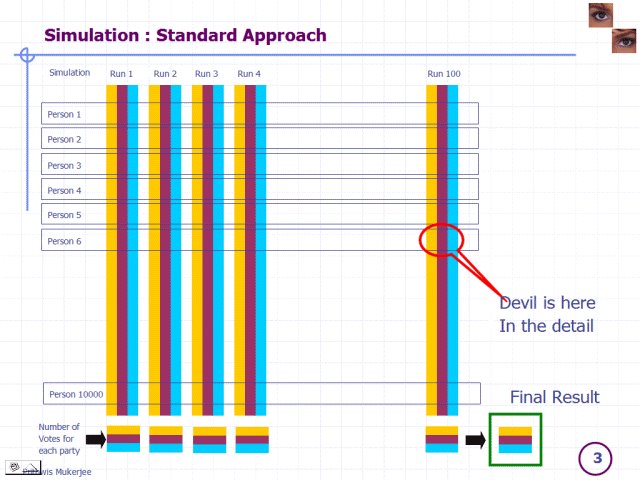
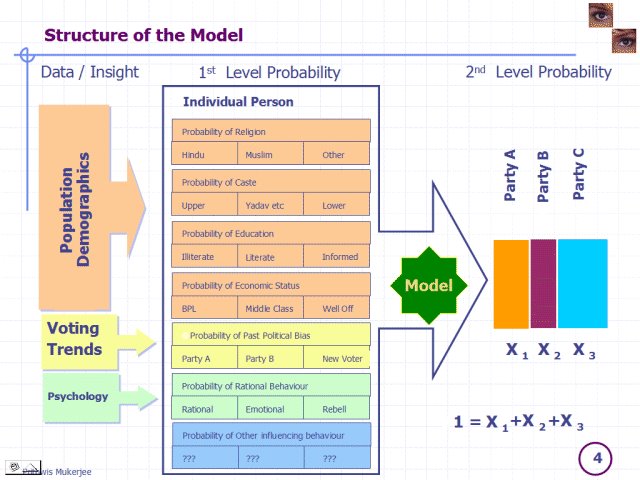
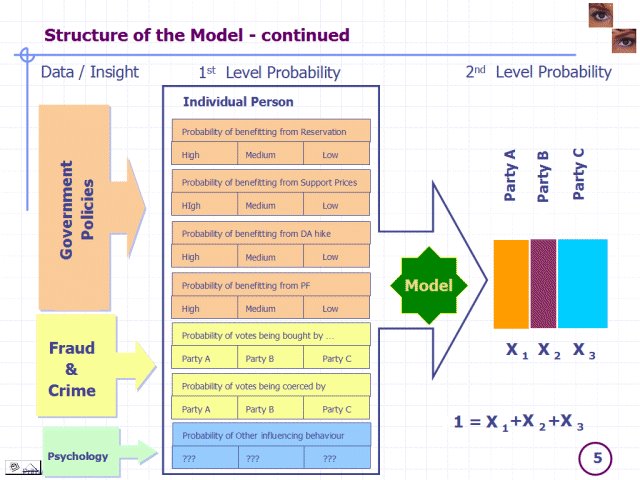
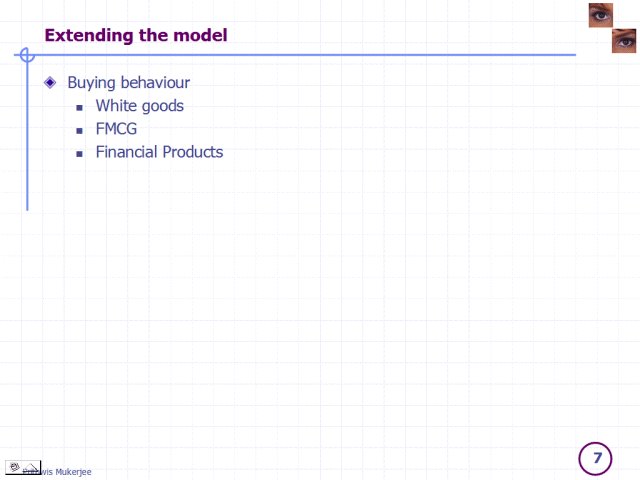
This is a schematic plan for modelling the behaviour of large and diverse populations. The original idea was to see how people could vote in an election but the this model can also be expanded to explore how people would respond to marketing initiatives in the retail and consumer space.


Wednesday, December 07, 2005

Calling the Bombay Film Industry to create MMORPG

Why am I obsessed with MMORPGs ? Because I firmly believe that MMORPG genre is the next big killer application of the same order of significance of Spreadsheets ( Visicalc and Lotus123 ... that took computers to every office desk ) and the Web Browser ( Mosaic / Netscape .. that drove computers into every home).

An MMORPG is infinitely more fun ( despite sneers from the high-brow crowd) than the usual computer game because of the presence of real, 'intelligent' human beings on the other end. Actually it is less of a game and more of a community where you learn to find your way around a new world, much like what travellers have to do in a strange new country. The immediacy of virtual environment and the extreme richness that is possible is mind boggling.

However building such a game is no child's play. You need complex game engines that deliver AI capabilities and then you have to add (a) graphics and (b) a compelling storyline. It is so expensive to build a game that it was possible ONLY for big corporations to get going.

But all this is ( or should ) change soon.

Multiverse is a very interesting site that helps you to build such a game with a ( relatively speaking !) very low investment. Strangely enough it is a free site and gives you all the tools that you need, PLUS the hosting servers etc, with which one can build a full fledged MMORPG game !! They have a sound economic model that is both fair and should be sustainable as well.

This is a huge opportunity for game developers in India. Thanks to the burgeoning film industry at Mumbai, Calcutta & Chennai ( I hate the pejorative and imitative term ... Bollywood ) there is no dearth of creative talent in this country. Why can some TV production houses not tie with creative elements and some computer programmers to kick start the process.

Let us hope that very soon, we will have companies of the size and visibility of Infosys, Wipro and TCS in this area.

Monday, November 21, 2005

MMORPG + the Matrix : a brave new world

After years of reading about MMORPG Worlds, I finally managed to find a reasonably good one that allows you to play for free see ... Planeshift After a few initial hiccups with the software, I finally managed to create an account, create a character ( avatar ), upload it and finally join the game. It was good, though I understand that the popular commercial ones are better ... But as they say in Bengali, a blind uncle is better than no uncle at all. Jokes apart, joining this game gave me a fairly good understanding of what these games are all about.

So what are they all about ? It is about a simulated world peopled by different races of people with each having slightly different characteristics. Is it not the same in our 'real' world ?

In such a world, you have the ability to create one or more 'avatars' or characters and through them enter the world. Initially it is a very lonely place, as it would be if you were dropped into another planet and asked to find your way through.

What can you do ? I am expected to strike deals and earn money, actually funny money with game currency, and use this to further my goals in this world. I could also explore new territory and find out new and wonderful things about this world.

What makes this games different from a normal computer game where you play against the AI-capable program of the computer is that there are other 'avatars' created by other live players. This gives it an element of reality ( and randomness, or non-determinism) that may be difficult to achieve in a pre-programmed environment.

However there are more effective doses of reality.

First the computer graphics are superb. You really feel that you are walking through a subterranean world ( in this case the setting is subterranean but there are other games that have different settings). The degree of reality is of course a function of the money that you have paid for the game ... after all the graphics designers would expect a decent salary if they are expected to work on the detailed graphics. But money is not the only solution to improving reality ... technology is.

Graphics on the screen is good but one would need other stimuli as well if you would like to replicate reality. Sound is easy and 3D imagery is almost here, thanks to lasers and holograms ... but touch ? smell ? and taste ?

Theoretically speaking, it is not impossible to recreate all this ... but could we really extend the user-interface to a totally new level of experience ?

We have all seen the Matrix. The original is ofcourse the best and 'demonstrates' the technology through which sensory stimuli can be sent directly into the brain. This means that one can experience stimuli without the pair of signal converters : screen-eye for visual images, speaker-ear for sound, and the corresponding pair for the three other senses.

Is this possible ? Is this feasible ? Of course it is. Just look up the embedded technology that has been pioneered by Kevin Warwick where he uses implants to exchange machine readable electronic signals with the actual nervous system. Similar technology has been used to help quadriplegic patients to control wheel chairs ... by simply using their 'will' to take action.

My hypothesis is that while advances in AI technology will make MMORPG games even smarter, the real smartness will come from having more and more people join the game and contribute their own intelligence towards making the game more compelling. However the introduction of direct, Matrix-style, nerve implants that do away with traditional user-interface technology will give a qualitative jump to the sheer richness of the game playing experience.

When will this happen ? I would say that this is not more than ten years away.